Workforce economics
The real cost of poor employee mental health in India
24 June 2026 · 7 min read · AhaTherapy team
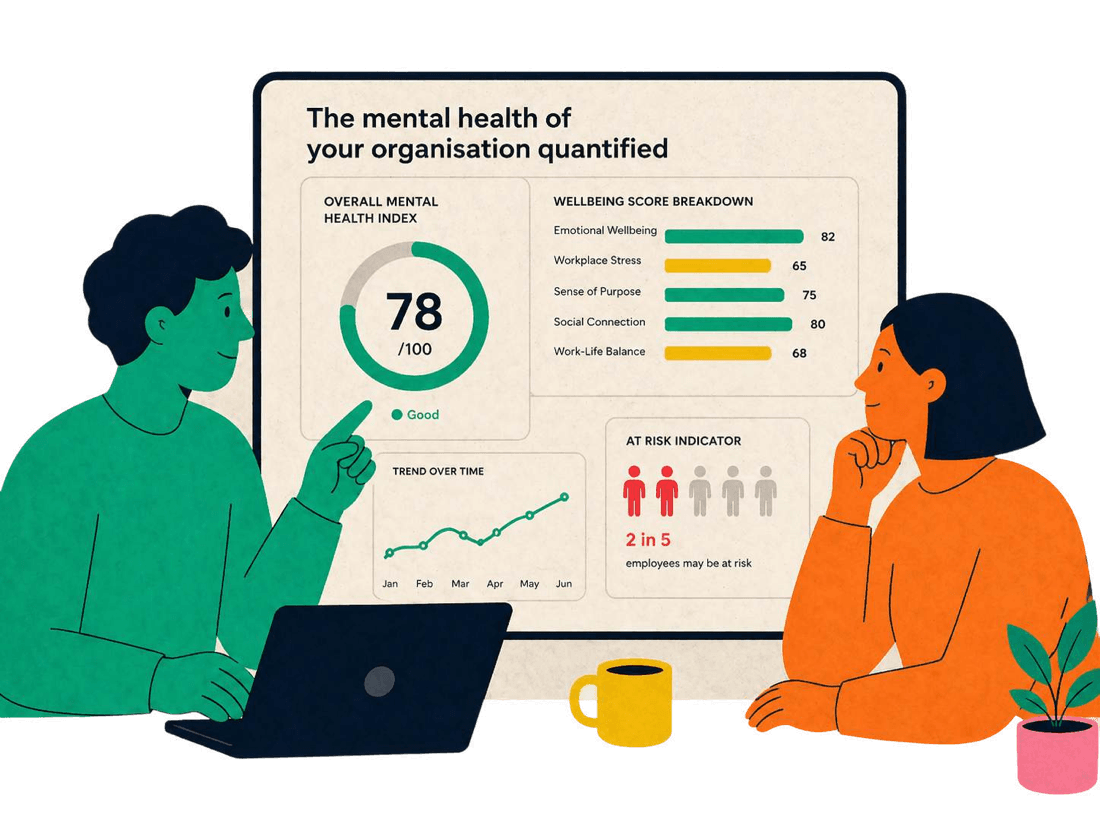
The cost of poor employee mental health in India is not a line item you will find in any budget review, which is exactly why it keeps getting paid. It does not arrive as an invoice. It arrives as a developer who is at her desk but cannot concentrate, a team lead who quietly checks out months before he resigns, a high performer whose replacement takes a quarter to ramp. None of that shows up as a discrete charge. All of it is real money, and most organisations are already spending it without ever deciding to.
The useful question for a People leader or CFO is not whether to start paying this cost. You are paying it now. The question is whether it stays invisible, spread thinly across payroll and attrition and missed deadlines, or whether you measure it and decide what to do about it. This piece tries to make that invisible cost legible, using figures you can check, and grounded in Indian workforce realities rather than imported benchmarks.
Two costs, and only one of them is obvious
When people picture the cost of poor mental health at work, they picture absenteeism: someone is unwell and does not come in. That cost is visible. It shows up in leave records, in shift gaps on the factory floor, in the scramble to cover a service desk. For shift-based and frontline roles, absenteeism is often the first signal HR sees, because attendance is tracked tightly and a missing person is immediately felt.
The larger cost is presenteeism: people who are physically present and on the payroll, but working at a fraction of their capacity because of anxiety, depression, burnout or sustained stress. Workplace-health research has repeatedly found presenteeism to be a bigger drain than absenteeism, often several times larger, precisely because it is continuous and unmeasured. Deloitte's UK analysis, for example, attributed substantially more of employers' mental-health cost to presenteeism than to outright absence. Treat the exact split as country-specific rather than universal, but the direction is well established: the part of the cost you cannot see tends to be bigger than the part you can.
In India this matters even more, because a salary on the books carries loaded costs around it. Provident Fund and ESIC contributions, gratuity accrual, variable pay and the overhead of managing a role all mean that a disengaged employee is not just costing you their take-home pay. You are funding the full loaded cost of a seat while getting a fraction of its output.
~12 billion
Working days lost worldwide each year to depression and anxiety (WHO estimate)
~US$1 trillion
Annual global productivity lost to depression and anxiety (WHO estimate)
~US$4 per US$1
Estimated return from scaled-up treatment of common mental disorders (WHO and The Lancet Psychiatry, 2016)
~0.5x to 2x salary
Estimated cost to replace an employee, depending on seniority (Gallup, SHRM)
What the global numbers actually say
The World Health Organization estimates that depression and anxiety cost the global economy roughly 12 billion working days and around US$1 trillion in lost productivity every year. Those are population-level figures, and no single employer should pretend to map them onto a spreadsheet line. But they establish scale: this is not a soft, peripheral concern, it is one of the largest sources of lost output in the modern economy.
On the other side of the ledger, a WHO-led study published in The Lancet Psychiatry in 2016 estimated that scaling up treatment of depression and anxiety returns on the order of US$4 for every US$1 invested, mostly through improved productivity and recovered ability to work. That ratio is an estimate at the level of economies over a 15-year horizon, not a guarantee for any one programme, so it should be read as a signal of order of magnitude rather than a promise. Deloitte's recurring work on the employer cost of poor mental health points the same way: when firms measure their own absenteeism, presenteeism and attrition costs against the cost of support, the support has tended to more than pay for itself.
The honest caveat is that these are ranges and estimates, sensitive to assumptions. The right response to that uncertainty is not to dismiss the cost, it is to measure your own.
Put a number on what you are already spending
Global averages do not pay your invoices, your own headcount and salary structure do. This calculator takes your team size, average loaded salary and a conservative productivity-loss assumption and estimates the annual cost your organisation is most likely absorbing right now through absenteeism, presenteeism and turnover. Adjust the inputs to your reality and see the figure for yourself.
Your organisation
Illustrative assumptions: roughly 40% of employees report work stress affecting their mental health; about 15% of working-age adults live with a mental health condition (WHO); stress-linked absenteeism and presenteeism cost in the region of 18 working days per employee a year, near 7% of payroll. Estimates, not diagnostics.
What is invisible today
200
employees likely carrying stress, anxiety or burnout signals
75
likely to need active clinical support this year
9,000
working days lost a year to absenteeism and presenteeism
₹3.15 Cr
estimated annual productivity cost
The WHO estimates every US$1 invested in scaled treatment for depression and anxiety returns about US$4 in improved health and productivity. A traditional EAP reaches fewer than 5% of the people above.
See what this looks like for your teamAttrition is where the cost gets sharp
Of all the ways poor mental health shows up on the books, replacing people is the most concrete. Gallup and SHRM have long estimated the cost of replacing an employee at somewhere between roughly one-half and two times their annual salary, depending on seniority and how hard the role is to fill. For a senior engineer or a hard-to-source specialist, the upper end is realistic once you add recruitment fees, the manager hours lost to hiring, lost institutional knowledge and the months a replacement needs to reach full productivity.
Burnout sits directly upstream of this. The WHO's ICD-11 classifies burnout as an occupational phenomenon resulting from chronic workplace stress that has not been successfully managed, defined along three dimensions: exhaustion, increased mental distance or cynicism toward one's job, and reduced professional efficacy. Read that definition closely and it describes the exact arc of a regretted resignation. The efficiency drop is presenteeism. The mental distance is disengagement. The exit is your replacement cost crystallising. People rarely leave in a single dramatic moment, they leave gradually and then suddenly, and the bill lands long after the warning signs were visible.
This is why mental health and retention cannot be treated as separate programmes. The same underlying condition that quietly lowers output is the one that eventually walks out of the door.
“Psychological safety is a belief that one will not be punished or humiliated for speaking up with ideas, questions, concerns or mistakes.”Amy Edmondson, Harvard Business School, on psychological safety
Why the cost stays hidden
If this cost is so large, why does it stay off the radar? Partly because the signals are quiet by nature. Edmondson's research on psychological safety, echoed by Google's Project Aristotle study of what makes teams effective, found that the strongest teams are ones where people feel safe enough to admit they are struggling. The corollary is uncomfortable: in workplaces without that safety, distress goes underground. Nobody is filing a ticket that says they are burning out. They are simply producing less, and you are paying full price for it.
There is also a measurement problem specific to mental health, and it is partly a trust problem. Asking employees to self-report wellbeing only works if they believe the data will not be used against them. In India, the Digital Personal Data Protection Act of 2023 sets out the ground rules that make this trust possible: consent, purpose limitation, and clear rights for the person the data is about. Handled well, that framework is not a constraint on measuring wellbeing, it is the precondition for measuring it honestly. People share truthfully when they can see that responses are anonymised, aggregated and used to change the workplace rather than to rank individuals.
Get the trust right and the hidden cost starts to become visible. Get it wrong and you are left guessing, while the spending continues.
A practical first step
Before commissioning any programme, size the cost you are already carrying. Take your headcount, your average loaded salary (include PF, ESIC and gratuity, not just CTC), a conservative productivity-loss assumption in the low single digits, and your current annual attrition rate with a mid-range replacement cost. Multiply it out. The number will not be exact, but it will be defensible, and it reframes every wellbeing conversation: you are not weighing a new expense against zero, you are deciding whether to keep paying an existing cost blindly or to redirect part of it deliberately.
Making the invisible cost a decision
None of this argues that mental health support is charity, or that it should be justified on sentiment. The argument is narrower and more durable: the cost is already real, already paid, and currently undecided. It sits inside your payroll as reduced output, inside your attrition as replacement spend, and inside your missed timelines as work that quietly did not get done. The only choice in front of a People leader or CFO is whether that cost remains an accident or becomes a decision.
Tools like Aha exist to help organisations make that cost visible and act on it within a framework employees can trust, with anonymised, aggregated insight rather than individual surveillance. But the first move does not require any vendor. It requires putting an honest number on what poor employee mental health is costing your organisation in India today, and then choosing, with eyes open, what to do with that number.
Frequently asked
How do you actually estimate the cost of poor employee mental health for one organisation?+
Start with the costs you can defend. Take headcount and average loaded salary (including PF, ESIC and gratuity, not just CTC), apply a conservative productivity-loss assumption for presenteeism and absenteeism in the low single-digit percentage of payroll, then add attrition cost using your current turnover rate and a mid-range replacement cost of roughly half to one times annual salary. The result is an estimate, not an audited figure, but it is grounded in your own numbers rather than global averages, which makes it far more useful for a budget conversation.
Is presenteeism really a bigger cost than absenteeism?+
Workplace-health research has repeatedly found presenteeism, people working while unwell or distressed, to be a larger drain than outright absence, often several times larger. Deloitte's UK analysis, for instance, attributed more of employers' mental-health cost to presenteeism than to absence. The reason is structural: absence is visible and tracked, so it gets managed, while presenteeism is continuous and unmeasured. Someone present but operating at a fraction of capacity costs you their full loaded salary for diminished output, every day, without ever showing up as a flagged event.
Does the Digital Personal Data Protection Act stop us from measuring employee wellbeing?+
No. The DPDP Act 2023 sets the conditions for measuring it responsibly rather than prohibiting it. Its core principles, consent, purpose limitation and clear rights for the individual, are exactly what make employees willing to answer honestly. The practical implication is to collect wellbeing data with consent, keep it anonymised and aggregated, use it to change the workplace rather than to assess individuals, and be transparent about all of this. Done that way, the law supports better measurement instead of blocking it.
What return can we realistically expect from investing in employee mental health?+
A WHO-led study in The Lancet Psychiatry estimated roughly US$4 returned for every US$1 invested in scaling up treatment of common mental disorders, mainly through recovered productivity. That figure is an economy-level estimate over a long horizon and should be read as an order of magnitude, not a guaranteed payback for any single programme. The more reliable case is internal: when organisations measure their own absenteeism, presenteeism and attrition costs against the cost of support, the cost being avoided is usually substantial, because so much of it is already being paid invisibly.
Aha for Work is a whole-person employee wellbeing platform: clinical mental health, physical health, life skills and financial wellness, with anonymised intelligence HR can act on. Book a consultation →