People analytics
What is a Workforce Wellbeing Index, and how do you build one?
27 June 2026 · 7 min read · AhaTherapy team
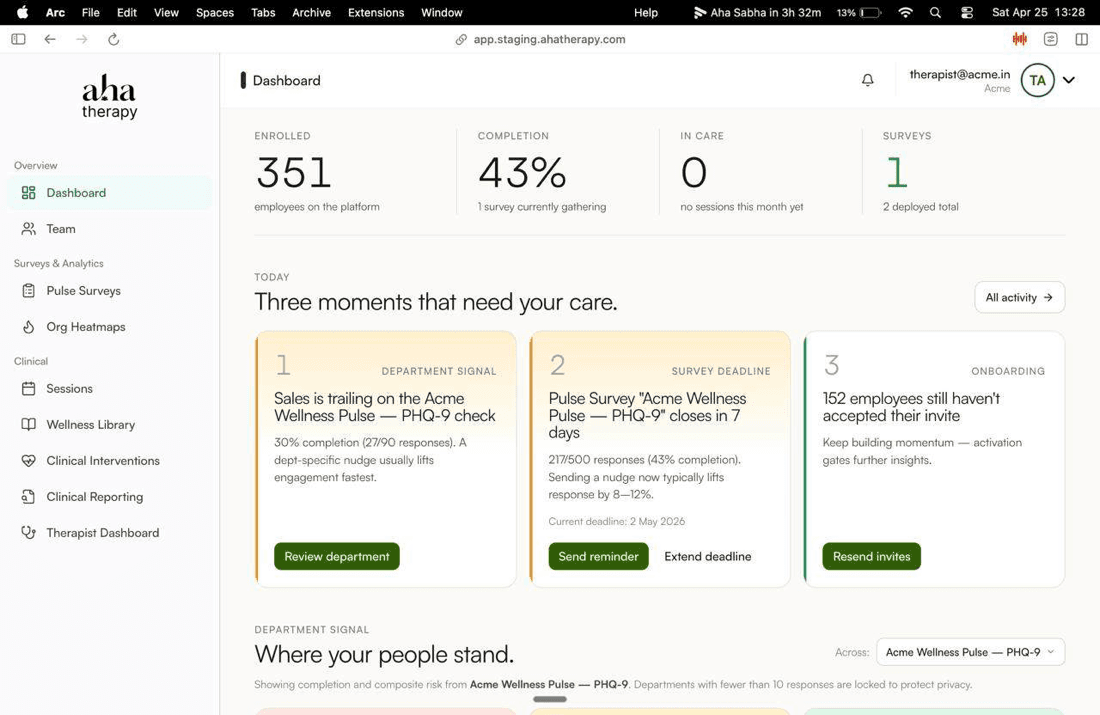
Most organisations already collect plenty of data about their people. Headcount, attrition, leave taken, the once-a-year engagement survey that lands in March and is forgotten by April. What almost none of them have is a steady, honest read on how their workforce is actually doing, week to week, before the resignation letter arrives or the team quietly stops trying. A workforce wellbeing index is an attempt to close exactly that gap.
Put simply, a workforce wellbeing index is a single, measurement-based score (usually a small set of sub-scores) that tracks the handful of human signals that tend to predict whether people stay and thrive: their energy, their engagement, how psychologically safe they feel, and whether they feel they belong. It is built from routine signal rather than one big annual survey, it is always reported by team and never by name, and its only real purpose is to tell leaders where to look and what to do next.
What the index is actually measuring
The temptation is to measure everything. Resist it. A useful workforce wellbeing index narrows to the few dimensions that research has repeatedly linked to retention and performance, and that people can answer honestly in a few seconds. Four tend to hold up well across settings: energy (am I depleted or recovered), engagement (am I absorbed in the work or just present), psychological safety (can I speak up, admit a mistake, or disagree without it being held against me), and belonging (do I feel part of this team).
Psychological safety is worth singling out because the evidence is unusually strong. Amy Edmondson's research at Harvard defined it as a shared belief that a team is safe for interpersonal risk-taking, and Google's Project Aristotle, its internal study of what makes teams effective, reported that psychological safety was the most important factor separating its higher and lower performing teams. It is not a soft extra. It is the precondition for people telling you the truth, which is the precondition for everything else an index is trying to surface.
Two clinical screens often sit alongside these dimensions when an organisation wants a distress signal rather than just a mood read: the PHQ-9 for depression and the GAD-7 for anxiety, both validated and widely used. They are powerful, and they are sensitive, so they belong inside a confidential clinical pathway with explicit consent, not casually averaged into a team dashboard. The index tells you a team's temperature. It should never expose any individual's diagnosis.
~US$1 trillion
estimated annual cost to the global economy in lost productivity from depression and anxiety, per the WHO and ILO
~12 billion
working days estimated lost worldwide each year to depression and anxiety (WHO and ILO)
~US$4
estimated return for every US$1 invested in scaled-up treatment for depression and anxiety (WHO-led analysis in The Lancet Psychiatry)
~0.5x to 2x
of annual salary as a commonly cited cost to replace a departing employee (SHRM and Gallup ranges)
Why it is built from routine signal, not the annual survey
The annual engagement survey has two structural problems. It is too infrequent to catch a team sliding, and by the time the results are read the conditions that produced them have often changed. A workforce wellbeing index instead samples lightly and often: a couple of questions in a weekly or fortnightly check-in, voluntary, takes under a minute. Frequency is what turns a snapshot into a trend, and a trend is what you can actually act on.
It also draws, carefully, on signals the organisation already holds. Not surveillance, and not anything that names a person, but aggregate patterns that are visible at the team level: leave clustering before a deadline, meeting load creeping past what is sustainable, attrition ticking up in one department while staying flat everywhere else. None of these mean anything on their own. Read together, against the self-reported dimensions, they form a picture. A drop in engagement scores in one team alongside rising leave and a recent reorganisation is a story worth a manager's attention.
Burnout is one pattern this combination can help catch early. The WHO's ICD-11 describes it through three components: feelings of energy depletion or exhaustion, increased mental distance or cynicism about the job, and reduced professional efficacy. Those map closely onto an energy and engagement read taken over time, which is why a falling index in one team can be one of the earlier visible signs of burnout building, sometimes well before it shows up as a resignation.
See how the index reads, team by team
Move through a sample organisation and watch the score break down by dimension and by team. Notice that you can see which teams need attention without ever seeing who answered what.
What's happening across your teams
Q2 2026Anonymised · cohort of 10+ · tap a team to drill in
Team Wellness
71
↑ 5 vs Q1
Team Engagement
38%
≈8× an EAP
Attrition risk
Low
↓ vs last year
Sessions
412
this quarter
Wellbeing breakdown
Engagement over time
Jan → Jun · 9% → 38%
By department
tap to drill inBy team, never by name
This is the principle that makes or breaks the whole exercise. The moment an employee suspects a manager can see their individual answers, honest reporting stops, and a dishonest index is worse than no index because it gives leaders false confidence. So the rule is absolute: results are aggregated to the team and never traceable to a person. In practice that means a minimum group size before any team result is shown at all (a floor of five respondents is a common, defensible threshold), so a small team's score can never be reverse-engineered down to one individual.
In India this is not just good practice, it increasingly intersects with legal expectations, and the points below are general orientation rather than legal advice. The Digital Personal Data Protection Act, 2023 sets out principles including consent, purpose limitation, and data minimisation for personal data, and mental-health information is sensitive by any reasonable reading even though the Act does not carve out a separate sensitive-data tier. Any wellbeing index handling Indian employee data should be built on explicit consent, a clear stated purpose, aggregation by design, and a clinical pathway that keeps individual scores separate from anything HR or a manager can see. If your vendor cannot explain in plain language who can see what, treat that as the answer, and take your own legal advice on your specific situation.
Aggregation is not a limitation to apologise for. It is the feature. A leader does not need to know that one named person in finance is struggling. They need to know that the finance team's psychological safety has dropped two quarters running, so they can ask better questions and change something structural. The index is a management instrument, not a personnel file.
The test of a good index: would your most sceptical employee opt in?
If an employee reads how the index works and concludes their manager could figure out their individual answers, you have not built a wellbeing index, you have built a surveillance tool that will be quietly gamed. Set a minimum group size before any result is shown, keep clinical screens like the PHQ-9 and GAD-7 inside a separate consented pathway, and be able to state in one sentence exactly who sees what. Trust is the raw material. Without it the numbers are fiction.
How leaders read it, and what to do with it
An index is not a verdict, it is a map of where to look. The right way to read it is comparatively and over time: a single score in isolation tells you almost nothing, but the same team trending down for two cycles, or one department sitting well below the rest, is a signal worth acting on. Look at the sub-scores rather than the headline, because the action for a team low on energy (workload, staffing, on-call load) is completely different from the action for a team low on psychological safety (how the manager responds to mistakes and dissent).
Then act at the level the data points to. A dip in one team is often a local, fixable thing: a manager under pressure, an understaffed quarter, a reorganisation that landed badly. A pattern across many teams is more likely structural and belongs to leadership: the leave policy, the shift roster, the way targets are set. For Indian employers this connects directly to operational levers you already control: PF and ESIC coverage that shapes what care people can access, shift-work and on-call patterns that drive the energy score, and the practical reality that for many employees, time off and affordable treatment are the interventions that actually move the number.
The financial case for acting is reasonably well documented and worth stating plainly to a CFO. Deloitte's UK work on the employer cost of poor mental health has reported that, on average, investment in workplace mental health tends to return more than it costs, and replacing an employee is commonly estimated at anywhere from roughly half to twice their annual salary on SHRM and Gallup ranges. An index that helps you keep ten good people who would otherwise have left can pay for itself many times over, in rupees you can put on a spreadsheet.
Where to start
You do not need a perfect index on day one. Start with three or four dimensions you can defend, a light cadence people will actually complete, a hard rule on minimum group size, and a clear consent story. Run it for two or three cycles before you read too much into any single number, because the value is in the trend, not the first data point. Resist the urge to add a dozen more questions the moment it works; the discipline of measuring few things well is what keeps response rates high and the signal clean.
Most of all, treat the index as the beginning of a conversation rather than the end of one. The score tells a manager where to look. The actual work (asking the team what is going on, changing the roster, fixing the thing that is grinding people down) is human, and no dashboard does it for you. At AhaTherapy we build this layer so that the measurement connects to real care rather than sitting in a slide, but the principle stands whoever you build it with: measure the few things that matter, protect the people answering, and use what you learn to change something. An index that nobody acts on is just a more expensive survey.
Frequently asked
How is a workforce wellbeing index different from our annual engagement survey?+
Frequency and intent. An engagement survey is usually annual, long, and retrospective, so by the time you read the results the conditions have often moved on. A workforce wellbeing index samples lightly and often (a couple of questions every week or fortnight) so you see trends in time to act, and it focuses on the specific signals that tend to predict retention and wellbeing rather than broad satisfaction. The two can coexist, but the index is the early-warning system the annual survey cannot be.
Can managers see individual employees' scores?+
No, and that is the point. A properly built index aggregates everything to the team level and enforces a minimum group size (commonly at least five respondents) before any result is displayed, so no team score can be traced back to one person. Sensitive clinical screens such as the PHQ-9 and GAD-7 should sit inside a separate, consented, confidential pathway and are never shown to managers or HR. If individual answers were visible, honest reporting would collapse and the index would be worthless.
Is collecting this data legal in India under the DPDP Act?+
It can be, when built correctly, and this is general orientation rather than legal advice. The Digital Personal Data Protection Act, 2023 is built on principles including consent, a clear stated purpose, and data minimisation, and mental-health information is sensitive by any reasonable reading. A well-designed index relies on voluntary participation with informed consent, aggregates by design so individuals are not identifiable, and keeps clinical data separate from anything an employer can see. Ask any vendor to explain, in plain language, exactly who can access what, and take your own legal advice on your specific circumstances before you proceed.
What is a realistic return on investing in workforce wellbeing?+
The figures are reasonably well documented, though they vary by study and country. The WHO and ILO estimate that depression and anxiety cost the global economy roughly US$1 trillion a year in lost productivity, and a WHO-led analysis in The Lancet Psychiatry estimated that scaled-up treatment returns about US$4 for every US$1 invested. On the retention side, SHRM and Gallup commonly put the cost of replacing an employee at roughly half to two times their annual salary. Even keeping a handful of good people who would otherwise have left can cover the cost of a wellbeing programme several times over.
Aha for Work is a whole-person employee wellbeing platform: clinical mental health, physical health, life skills and financial wellness, with anonymised intelligence HR can act on. Book a consultation →